

In the cement industry, Packaging failures mean product loss, safety risks and wasted time on the job site. Zhejiang Saiqiang Plastic Co., Ltd. manufactures cement bags built to take the punishment — high stacking pressure, rough handling, moisture and long-distance transport — so your cement arrives dry, intact and ready to pour.
Our woven cement bags are made from high-tenacity PP fabric with high tensile strength and excellent stacking performance, available in standard 50kg cement bags and custom sizes. For premium requirements, paper cement bags and Paper-Plastic Composite Bags offer a clean, printable surface with added moisture protection.
Cement hardens when exposed to moisture, which makes moisture proof cement bags essential. Our bags can be equipped with lamination and inner liners that keep humidity out from the plant to the job site, preserving product quality and shelf life.
Most cement and dry mix orders are settled by five decisions. The table below shows what we run as standard and what each choice changes on your packing line.
| Specification | What we run | What it changes |
| Bag construction | PP woven, paper-plastic composite, multi-wall kraft | Woven resists tearing in rough handling; kraft holds fine print and recycles easily |
| Load per bag | 25 kg, 40 kg, 50 kg | Fabric weight and ply count scale with the fill weight |
| Barrier | BOPP lamination or PE inner liner | Blocks humidity during sea freight and monsoon storage |
| Closure | Sewn top, pasted bottom, or self-sealing valve | Valve suits automatic filling; sewing suits manual lines |
| Printing | Flexo up to 8 colours, MOQ from 500 pcs | Carries brand, cement grade and handling marks |
Start from the equipment, not the bag. Automatic valve packers need a bag with a correctly positioned valve sleeve, because a valve that sits a few millimetres off centre will leak dust at every cycle. Manual and semi-automatic lines are more forgiving and normally run sewn-top sacks. Then match the barrier to the journey: a 50 kg sack consumed within a week on a domestic site rarely needs a liner, while the same sack shipped in a container for six weeks almost always does. Finally, confirm the pallet pattern; a bag that is 20 mm too wide will not stack six across a 1.2 m pallet and will cost you container space on every load.
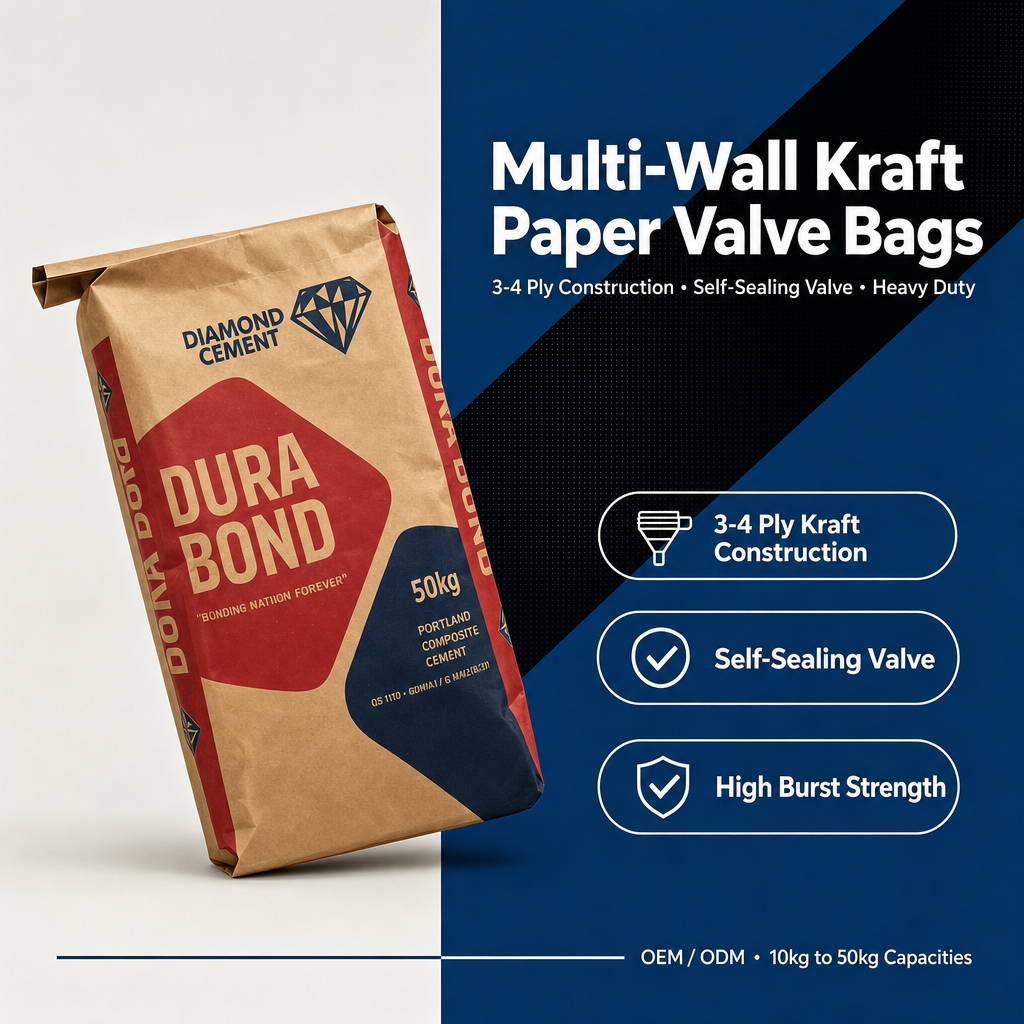
For automatic packing lines, our valve cement bags offer fast, dust-free filling with self-sealing valves — reducing dust in the plant and speeding up production. Every valve cement bag is customized to your valve size and filling equipment, and multi-ply kraft valve sacks for 50 kg cement loads can be built from three or four virgin kraft plies when recyclability matters in your market.
The most expensive error is specifying by dimension alone. Two sacks can measure the same and still behave differently, because gsm, tape width and stitch density decide whether a 50 kg bag survives a two-metre drop. The second mistake is ordering print before the bag is fixed: artwork approved on a woven bag will look different on a laminated or kraft surface, so approve a sample of the real substrate. The third is forgetting the closure. Buyers often confirm the bag and valve, then discover their packer cannot seal the top they ordered, which means a second production run and a delayed shipment.
As an experienced cement bag supplier, we provide cement Packaging bags with custom printing, professional export documentation and strict quality control. Send us your fill weight, packer model and destination port, and we will come back with a bag structure and a quotation — or simply talk to our packaging engineers about your current specification. You can also review the full range on our multi-ply kraft valve sack page before you decide.
There is no single answer, because strength depends on how the bag is handled. For rough manual handling and repeated stacking, a woven PP sack with higher gsm and reinforced stitching usually survives better. For automatic filling and clean palletising, a three or four ply kraft valve sack carries 50 kg comfortably, and the paper plies resist bursting when the sack is dropped.
Only when the cement will meet humidity. A liner or a laminated outer layer slows the moisture vapour that turns powder into lumps, and it matters most for sea freight, monsoon-season storage and long distributor chains. For bags filled and used within days in a dry climate, an unlined woven sack is usually sufficient and cheaper.
Yes. Flexographic printing runs up to eight colours on woven, paper-plastic and kraft cement bags, which covers a logo, cement grade, weight, batch area and the standard handling symbols. We print from your artwork files and send a proof for approval, so text placement and colour order are confirmed before production starts.
Custom printed cement bags start from 500 pieces per size and design, which keeps a trial order practical for a new market or a new cement grade. Below that volume, plain bags from stock are the better option. Lead time is confirmed once artwork and bag structure are approved, and samples can be arranged before the bulk run.
Correspondência

Este site usa cookies para garantir que você tenha a melhor experiência em nosso site.


 English
 Español
 Pусский
 Français
 العربية


 Whatsapp
 Telefone
 Correspondência
 mensagem
Comente
(0)